Meme Coin Trading, What $450,000 in 30 Days Actually Teaches
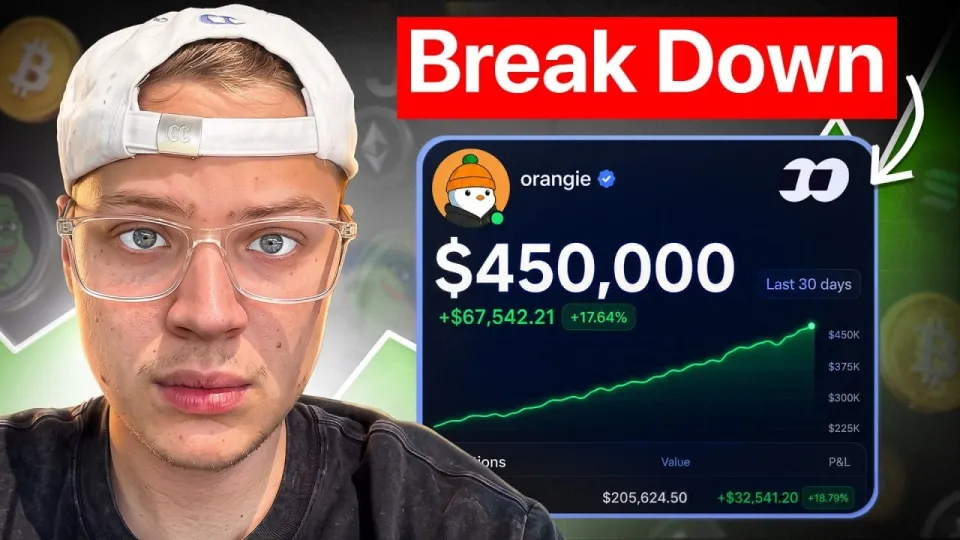
Video: How I Made $450,000 Trading Memecoins in 30 Days
Want articles like this for your own video to promote it on YouTube and Google? Order them through the Telegram bot @sat_sit_bot. It writes articles around your video, embeds the video and publishes them on popular niche websites (no ads). Free trial — 50 articles.
A meme coin is a crypto token with no product, revenue or cash flow behind it, whose price is driven almost entirely by attention and liquidity. The $450,000-in-30-days case presented by Orangie Web3 is a real but extreme outcome, and the same mechanics that produced it are what wipe out most participants. Anyone who wants to understand the niche should start with the trader's community and tooling, which is bundled through the Kaizen group membership, and then treat every number in that story as a best case rather than a baseline.
What a meme coin actually is and why it moves so fast
A meme coin is a token whose value rests on a story, a character or a joke, and the market prices that story in minutes rather than quarters. On Solana, where most of this activity sits, a token can be created on a launchpad, seeded with a few thousand dollars of liquidity and reach a seven-figure valuation before the average trader finishes reading the ticker. There is no earnings report to wait for and no roadmap to check, so the only inputs are who is buying, how much liquidity sits in the pool and how quickly holders exit.
The mechanics that matter are simple to state and hard to trade:
- Liquidity depth. A pool with $30,000 of liquidity cannot absorb a $10,000 sell without collapsing the price. Thin pools move violently in both directions.
- Holder concentration. If a handful of wallets hold a large share of supply, those wallets decide when the run ends.
- Launch structure. Fair launches, presales and bundled launches behave differently; bundled supply means insiders can dump on retail buyers.
- Narrative timing. A token tied to a trending meme or a well-known figure can run for hours; one without a narrative usually dies in minutes.
Because none of these factors appear on a normal chart, meme coin trading is closer to reading order flow and social momentum than to technical analysis.
How the $450,000 month was built
The $450,000 result came from a small number of outsized winners rather than consistent, evenly sized gains. In the video, the trader walks through his own entries and exits on Solana meme coins and explains why he chose each one, which is the part of the process most viewers ask to see repeated. The structure behind that kind of month is usually the same: many small positions, a handful of large multiples, and a strict willingness to cut the rest.
What the case study illustrates is position sizing under uncertainty. A trader who risks a small fixed amount per token can be wrong nine times and still be profitable if the tenth returns twenty times. A trader who puts a large share of capital into one coin is making a single bet, and single bets on tokens without fundamentals fail often. The reported figure also reflects compounding during a hot stretch: profits from early winners get recycled into later ones, so the final number is not the sum of independent trades but the result of a sequence that only works while the market stays hot.
The infrastructure advantage nobody advertises
Access is the real edge in meme coin trading, and it is rarely the headline of a success story. The traders posting six-figure months are typically inside private groups where calls are shared, wallets are watched and entries are coordinated within seconds of a launch. That is not a conspiracy; it is simply how speed-dependent markets organise themselves. A retail trader refreshing a public feed is competing against people who already know which contract is about to be bought.
Practical consequences follow from this:
- Tools matter more than opinions. Sniping bots, wallet trackers and fast execution interfaces shorten the gap between seeing a token and buying it.
- Calls are not free signals. A group call that reaches thousands of people at once moves the price before most members can act, which is why early access and small groups outperform public alerts.
- Slippage is a real cost. On thin pools, a fast entry can fill several percent above the quoted price, and an exit can fill several percent below it.
- Wallets are public. Copy-trading a profitable wallet is possible, but so is being front-run by anyone watching the same address.
The honest framing is that the people making consistent money in this niche are usually selling access, tools or education alongside their trading, because trading income alone is volatile.
Common questions and doubts from new traders
New entrants consistently raise the same concerns, and they are worth answering directly rather than dismissing. The most frequent is pace: viewers say the material moves fast, jumping between tokens and concepts. That is a fair criticism, and the practical fix is to slow the process down yourself, pausing on each trade to identify the entry reason, the exit plan and the invalidation point before moving on.
The second recurring theme is losing money early. Many beginners report putting in a small amount, losing most of it while learning the interface, and then hitting one token that recovers the losses. That pattern is real, but it is survivorship in action: the people who post about the recovery are the ones who got it, and the ones who did not simply stop posting. A third theme is the honest admission that the trader is in a group with other strong traders who share calls, which changes the difficulty level considerably compared with someone trading alone from a public feed.
A useful checklist before any entry:
- Can you afford to lose the entire position without changing your life?
- Do you know who holds the supply and whether insiders can sell?
- Is there enough liquidity to exit your size at a reasonable price?
- Do you have a defined exit, or are you hoping?
- Are you following a narrative you understand, or a ticker someone shouted?
Risk, regulation and the part that does not make headlines
Meme coin trading is a negative-sum game after fees, slippage and failed launches, which means the average participant loses. Every winner is funded by several losers, and the losers are usually the slowest and least informed. Rug pulls, where developers remove liquidity or dump pre-mined supply, remain common on permissionless launchpads, and no amount of chart study protects against a contract that was written to extract money.
There is also a growing regulatory dimension. Regulators in several jurisdictions have started treating aggressively marketed tokens as securities or as deceptive promotions, and platforms that list them face pressure. For a trader, the practical implications are tax reporting on every swap, the risk of a platform restricting access, and the possibility that a token you hold becomes untradeable on the venues you use. None of this makes meme coins illegal, but it does mean the niche is not a frictionless casino.
The most defensible approach is boring: size positions so that a total loss is survivable, keep records, avoid leverage, and treat profits as realised only when they are out of the position and, ideally, out of the ecosystem.
Useful links
- Kaizen group membership — the paid community referenced in the video.
- FOMO trading platform — the interface used for entries and exits.
- Orangie Discord — discussion and calls.
- Orangie on Instagram — short-form updates.
Final thoughts on the $450,000 meme coin month
The $450,000 figure is a genuine data point about what is possible in a hot meme coin market, and a misleading one if treated as a target. What transfers from the case study is process: small fixed risk per trade, fast execution, access to information before the crowd, and the discipline to accept many losses for a few large wins. What does not transfer is the outcome, because the same strategy applied in a cold market produces a slow bleed. Orangie Web3 deserves credit for showing actual entries and exits rather than only the profit screenshot, and for anyone serious about the niche, the Kaizen group is where that process is documented day to day. Trade with money you can lose entirely, and assume the first several months are tuition.
Key takeaways
- The case study is a trader who reports turning roughly $450,000 in profit from meme coins within 30 days, documented on the Orangie Web3 channel.
- Meme coins are tokens with no cash flow or product; price is driven almost entirely by attention, liquidity and holder behaviour.
- Most activity in 2026 happens on Solana launchpads, where a token can go from creation to a multi-million-dollar valuation in hours.
- The main edge discussed is access and speed: private groups, early calls and sniping tools, not chart reading.
- A realistic outcome for most participants is losing the majority of a position; one winner is expected to pay for many losers.
Questions & answers
How much money do you need to start trading meme coins?
You can start with a small amount, often a few hundred dollars, because many Solana tokens have low entry prices. The constraint is not the minimum buy but the fees, slippage and the number of attempts needed before a winner, so starting small and treating early losses as tuition is the realistic approach.
Why do most people lose money on meme coins?
Because the game is negative-sum after fees and slippage, and the fastest, best-informed participants take profit from slower ones. Thin liquidity and concentrated supply mean insiders can exit before retail buyers react, and the average outcome across all participants is a loss.
Is it worth paying for a trading group or signals?
Groups can shorten the learning curve and provide earlier information, but they are not guarantees and the price should be weighed against your position size. Many successful traders earn from memberships and tools as well as trading, which is worth knowing before you pay.
Can meme coin profits be repeated consistently?
Rarely at the same scale. A $450,000 month depends on a hot market, several large multiples and compounding during that stretch, and the same strategy in a cold market produces losses. Consistency comes from risk control, not from expecting the same result every month.
Source: How I Made $450,000 Trading Memecoins in 30 Days · Markdown version